

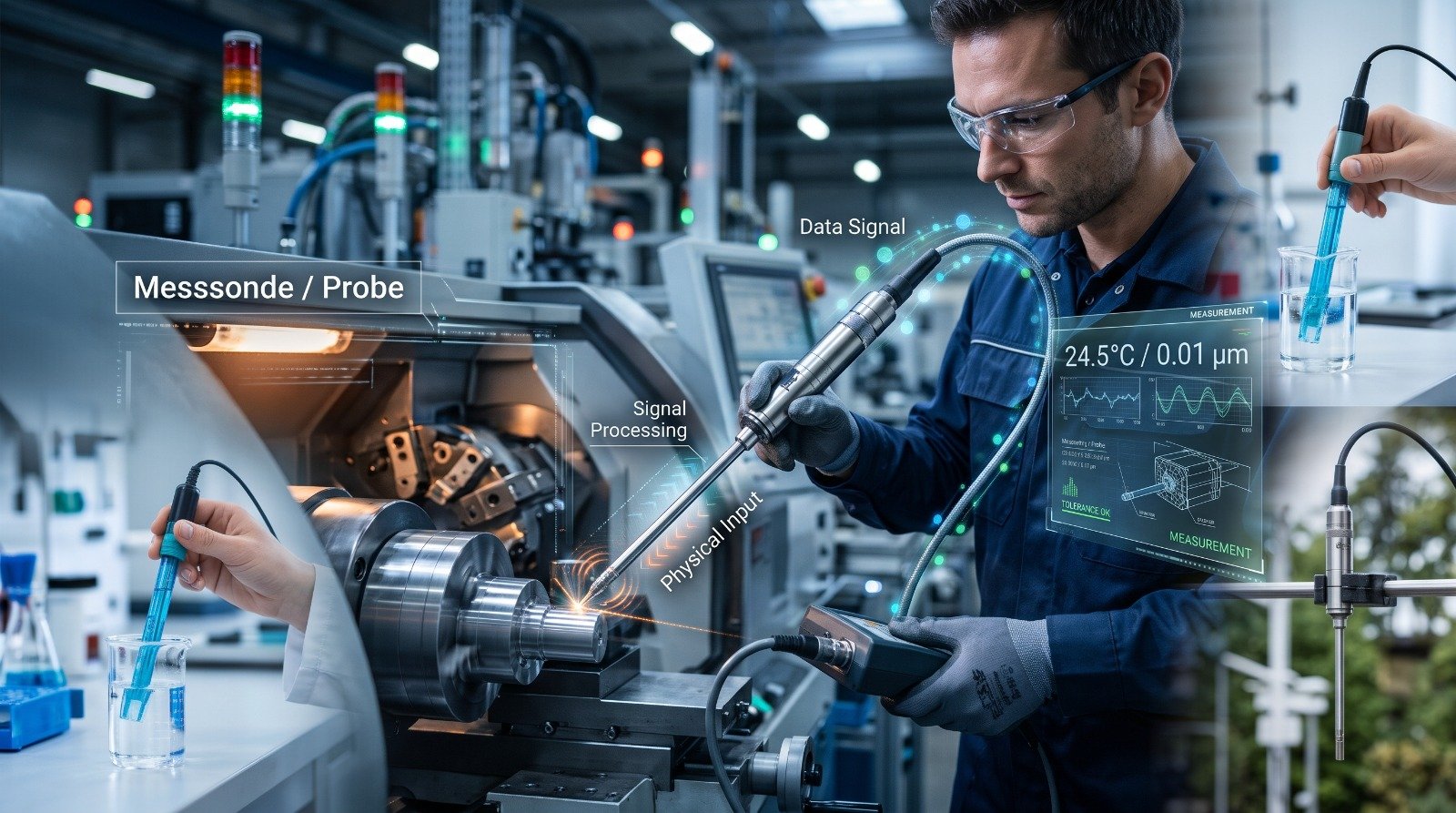
If you have ever worked in a laboratory, a factory, a greenhouse or a water treatment plant, you have almost certainly handled a messonde without giving the word much thought. The term comes from German, where it simply means a measuring probe: a slim, purpose-built device that goes into a material, a liquid or a stream of air and reports back on what it finds. Temperature, conductivity, pressure, moisture and flow are among the most common readings.
Outside German-speaking countries, the word has begun to surface in online searches, and people are naturally curious about what it refers to. This guide explains the idea in plain language, shows how these probes work, looks at where they are used, and offers practical advice on choosing and maintaining one.
What the Word Actually Means
German likes to build long words out of short ones, and this is a tidy example. Messen means to measure and Sonde means probe, so a messonde is any probe designed to take a reading at one specific point. It might sit inside a pipe, be pushed into farmland, hang down a borehole, or be mounted under the wing of a research aircraft to sample the air.
You may also notice the word being used as a vague, brand-style label on a handful of small websites that never quite say what it is. Pages like that are not a reliable guide. The established meaning, the one engineers, technicians and researchers rely on every day, is the measuring probe, and that is what this article covers.
How a Measuring Probe Works
Probes differ enormously in shape and price, yet most of them follow the same chain of events.
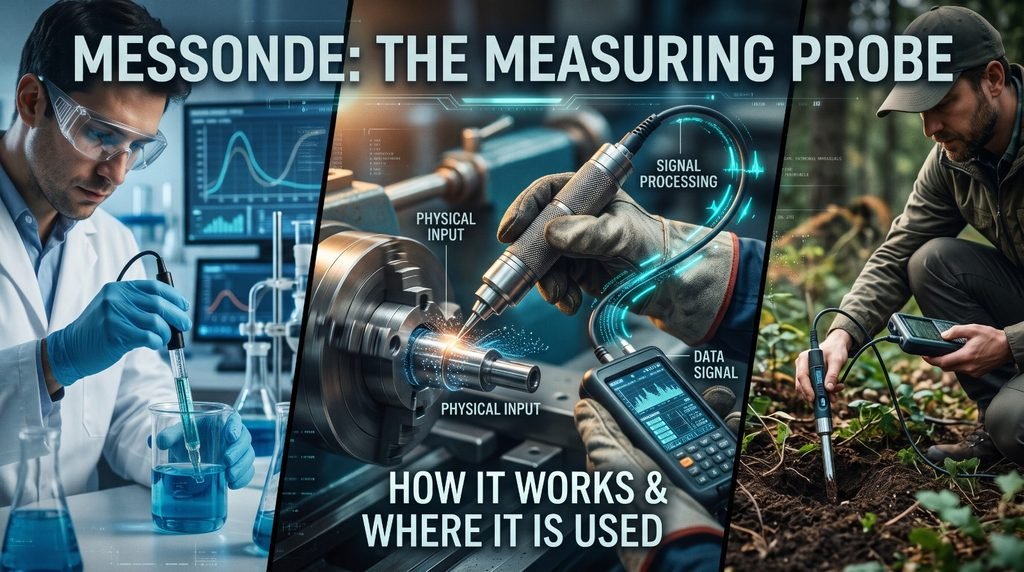
First comes the sensing element, the part that actually meets the thing being measured. In a temperature probe this might be a thermocouple or a platinum resistor. In a conductivity probe it is a pair of electrodes. In a moisture probe it is often a set of metal prongs that respond to how well the surrounding soil conducts a small signal.
Next is signal conditioning. The raw response from the sensing element is usually tiny and noisy, so electronics amplify it, filter out interference and convert it into something stable, such as a voltage, a current loop or a digital value.
Finally, the reading is delivered. That could be a small screen on a handheld meter, a cable running to a controller, or a wireless link sending numbers to a dashboard every few minutes. The key idea is that every messonde turns a physical quantity into information a person or a machine can act on.
Because the sensing element sits right in the process, the housing matters as much as the electronics. A probe that corrodes, cracks or fouls will lie to you quietly, which is worse than failing loudly.
Common Types You Will Meet
Temperature probes are the most familiar. They range from rugged stainless steel rods used in food processing to extremely thin versions where miniaturisation and corrosion resistance are essential.
Conductivity and water-quality probes estimate how many dissolved salts or minerals are in a liquid. Handheld water testers with a separate probe on a cable are a common sight in aquaculture, swimming pools and drinking water checks.
pH and chemical probes measure acidity and are widespread in laboratories, breweries and chemical plants.
Soil moisture probes help farmers and gardeners irrigate when plants need water rather than on a fixed timetable. Some are buried permanently and connected to irrigation controllers by long cables.
Pressure and flow probes monitor liquids and gases moving through pipework, which is vital for heating systems, cooling towers and compressed-air networks.
Inclinometer and geotechnical probes track tiny movements in slopes, dams and foundations. Chains of probes installed in a borehole can reveal ground shifting long before it becomes visible on the surface.
Where Measuring Probes Are Used
The list of fields is long, but a few stand out.
In manufacturing and energy, probes keep processes inside safe and efficient limits. A cooling tower, for instance, may use a conductivity probe to decide when to flush water and when to leave it alone, saving both water and chemicals.
In agriculture, readings from the root zone let growers cut waste and avoid stressing crops. Even modest installations can noticeably reduce water use over a season.
In environmental science, probes monitor rivers, groundwater wells and the atmosphere. Research aircraft carry particle sensors to study emissions high above the ground, and technicians must service them carefully after every flight.
In healthcare and dental research, small contact probes are used to take electrical measurements on samples and tissue, where repeatability from one operator to the next is a genuine concern.
In construction and civil engineering, monitoring probes provide early warnings about structural or ground movement. In each of these settings, a reliable messonde is not a luxury accessory but the first link in a chain of decisions.
How to Choose the Right One
Picking a probe can feel overwhelming because the catalogues are packed with specifications. A simple checklist keeps things manageable.
- Define the measurement range. A probe that tops out near your normal operating value leaves no safety margin. Choose a range that comfortably covers your extremes.
- Decide how accurate you need to be. Higher accuracy costs more and often requires more frequent calibration. Do not pay for precision you will never use.
- Consider response time. If conditions change quickly, a slow probe will always be playing catch-up.
- Match the materials to the environment. Seawater, acids, high heat and abrasive slurries all punish different metals and plastics.
- Check the physical details. Cable length, connector type, ingress protection rating and mounting style should suit your installation, not force you to improvise.
- Confirm compatibility. Make sure the output signal works with your existing meter, controller or data logger.
- Ask about calibration. Find out whether the supplier offers calibration standards or service, and how often the probe will need attention.
Spending an extra hour on these questions before buying usually saves days of frustration afterwards.
Calibration and Care

Even the best messonde drifts over time. Sensing elements age, electrodes get coated, and cables suffer from repeated bending. Calibration brings readings back in line with a known reference, and it should be treated as routine maintenance rather than an emergency fix.
A few habits make a real difference:
- Clean the probe according to the manufacturer’s instructions, and use the right solution for the type of fouling.
- Store it in the condition recommended for its type. Some probes must stay moist, while others should be kept dry.
- Record every calibration date and result. A log reveals slow drift that a single check would miss.
- Handle cables gently and avoid sharp bends near the connector, which is where most failures begin.
Mistakes People Often Make
The most common error is trusting a reading without questioning it. If a value looks strange, check the probe before blaming the process. Another frequent problem is poor placement. A temperature probe placed in a dead spot of a tank, or a moisture probe pushed in near a leaking pipe, will give accurate readings that are completely unrepresentative.
People also forget about response time and take notes the moment they insert a probe, before the sensing element has settled. Finally, skipping calibration because “it worked last year” is how small errors grow into expensive ones. A well-chosen messonde only delivers value when it is installed thoughtfully and checked regularly.
Where the Technology Is Heading
Measuring probes are quietly becoming smarter. Many now include built-in digital electronics that store their own calibration data, so a replacement can be swapped in without recalibrating the whole system. Wireless versions remove the need for long cables in awkward locations, and low-power designs can run for months on a small battery.
Connected monitoring is also changing expectations. Instead of walking around with a handheld meter, teams increasingly watch live trends on a screen and receive alerts when a value drifts. That shift favours probes with stable long-term performance and good diagnostics, because a sensor that can report its own health is far more trustworthy than one that fails silently. Expect the humble messonde to keep shrinking, getting cheaper and becoming easier to integrate with the software around it.
Frequently Asked Questions
Is a measuring probe the same as a sensor?
Almost. A sensor is the sensing element itself, while a probe usually describes the complete assembly, including the housing, cable and sometimes the electronics.
How often should a probe be calibrated?
It depends on the type, the environment and the accuracy you need. Harsh conditions call for more frequent checks, and the manufacturer’s guidance is the best starting point.
Can one device measure several things?
Yes. Multi-parameter probes combine several sensing elements, for example temperature, conductivity and pH, in a single body, which is handy for water monitoring.
What does a messonde cost?
Prices range from a few dozen dollars for simple handheld probes to thousands for specialised industrial or geotechnical installations.
Final Thoughts
A messonde may not be glamorous, but it is the quiet foundation of modern measurement. Whether it is guiding irrigation in a field, protecting a cooling system, or watching a hillside for movement, it gives people the facts they need to make better decisions. Understanding how it works, how to choose one and how to look after it will help you get reliable readings and avoid costly surprises, whatever your field.

1 Comment
Pingback: HRMS Globex: A Practical Guide to the HR Portal - Bin Weekly